
The limit switch is perhaps one of the most basic yet indispensable parts in industrial automation. Although small in size, it serves a very critical purpose of ensuring that machines work safely, precisely, and with specific limits. Limit switches have numerous applications ranging from conveyor belts, packaging machines, cranes, elevators, and CNC machines among others.
However, because of the different types, specifications and mountings of limit switches, selecting the appropriate one can be quite daunting. Selecting an inappropriate switch can result in constant breakdown, false triggering and even safety threats at the plant. In this guide, we will take you through all that you should know about selecting a limit switch for your industrial automation.
What Is a Limit Switch?
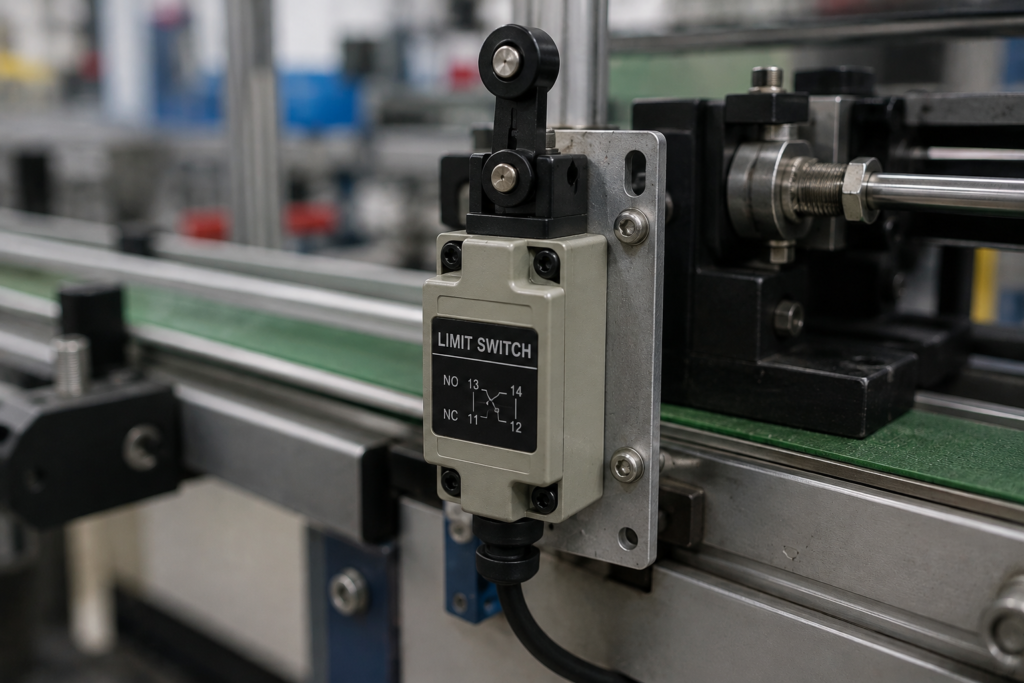
A limit switch is an electromechanical component which senses the presence, absence, or location of an object and generates an electrical impulse from this mechanical action. Once the moving element – such as a lever, roller, or plunger – gets to a particular physical position, the switch activates a circuit that halts, starts, reverses, or slows down the machine’s movement.
Limit switches are widely used in:
- Overhead & Gantry Cranes (Travel and hoist limitation)
- Conveyor (Jambing protection and location)
- Packaging and Bottling Equipment
- Lifts and Elevators
- Automatic Doors and Gates
- CNC and Robotic Equipment
Types of Limit Switches
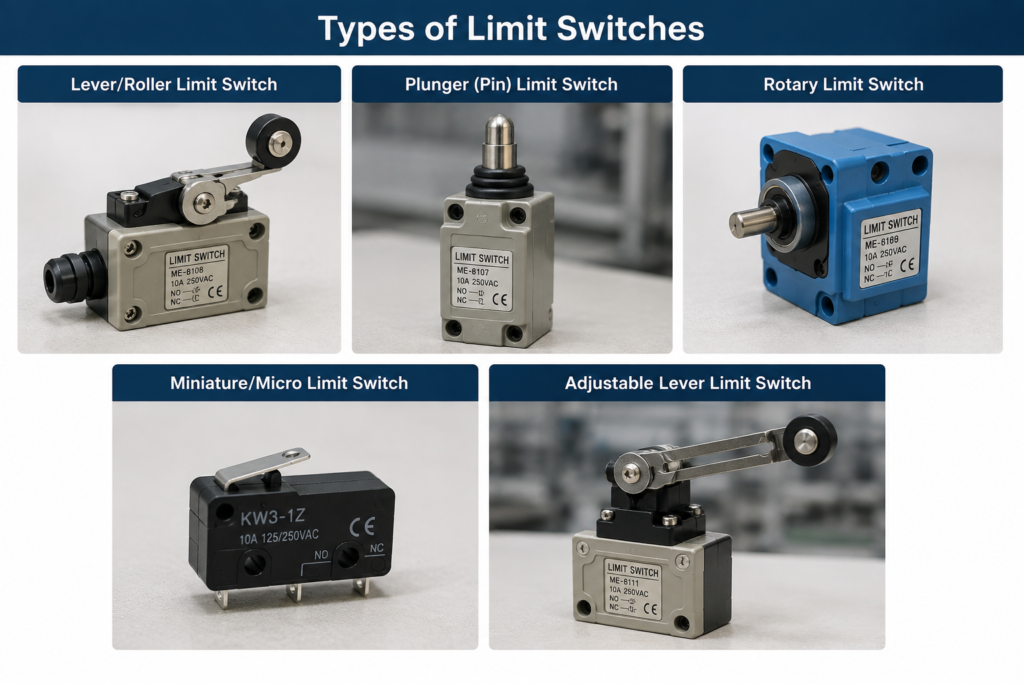
It is important to know the different types of limit switches before purchasing one:
1. Lever/Roller Limit Switch
This type of limit switch contains a lever and roller, which are activated because they get pressed against an object. They are commonly used in conveyors and cranes.
2. Plunger (Pin) Limit Switch
Actuated due to the actuation of plunger or pin directly by pressing force. Very good for tight spaces.
3. Rotary Limit Switch
Uses rotating cam mechanism. Used in cranes and hoists for controlling multiple travel limits using one device.
4. Miniature/Micro Limit Switch
Miniature sized switches that are mostly used in control panels.
5. Adjustable Lever Limit Switch
Can be adjusted during actuation if required.
Key Factors to Consider When Choosing a Limit Switch
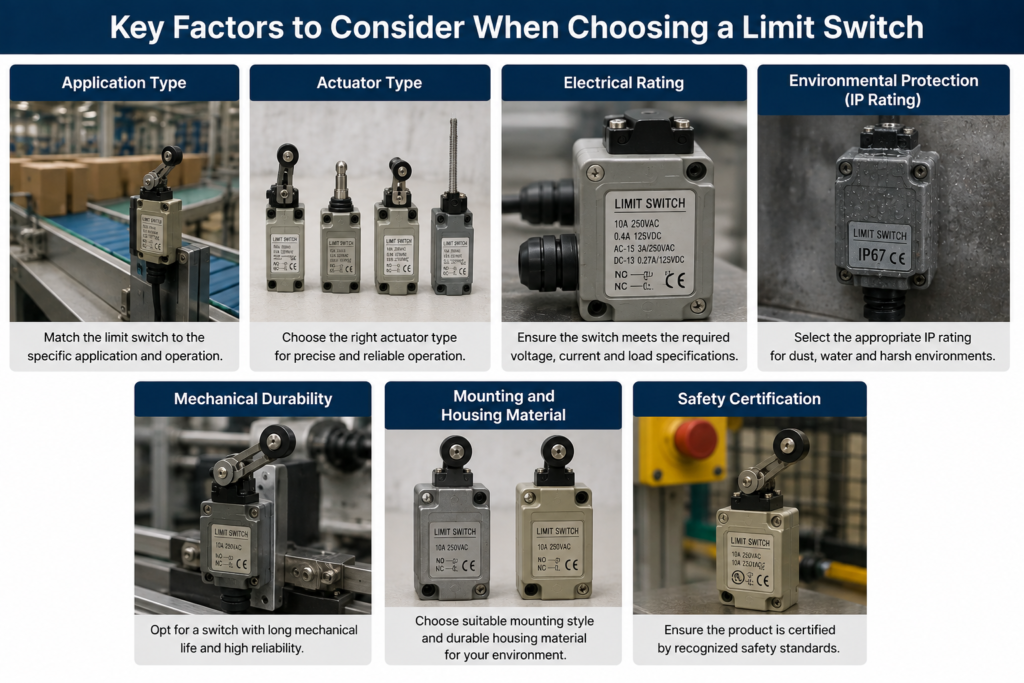
1. Application Type
The type of application determines what kind of the switch is needed for such purposes as position sensing, travel limiting, safety interlocking, counting etc. For instance, limit switches are used for crane hoist limits but need to be very robust, while plunger switches are usually fast responding switches.
2. Actuator Type
The switch needs to have the same actuator as the target object will approach it – lever, roller, plunger or wobble stick. It depends on the movement direction and nature of the object.
3. Electrical Rating
It is necessary to check voltage and current ratings of the limit switch to make sure that it is compatible with the control circuit. The typical voltage and current ratings for industrial limit switches vary from low-voltage DC control circuits to high AC ratings (for direct motor control).
4. Environmental Protection (IP Rating)
Industrial conditions are characterized by dust, water, oil, and vibration exposure, and therefore it is recommended to have the IP rating not less than IP65.
5. Mechanical Durability
Operating life is important to consider since it is measured in millions of cycles, and in the case of conveyor and packaging lines the switches can operate very frequently.
6. Mounting and Housing Material
There are metal-bodied switches (made of die-cast aluminium or stainless steel) and plastic ones and in most cases, it is better to choose metal one for industrial applications.
7. Safety Certification
For safety-critical applications limit switch should have positive-opening contacts and be certified according to the certain standard.
Installation and Maintenance Considerations
Selecting an appropriate limit switch is just the first step in ensuring its longevity and proper operation – installation and maintenance must also be considered.
Installation of limit switches typically requires cutting, stripping, and terminating of cables in order to ensure their connection to the control panel. In this case, having the correct tools is crucial. The ratchet cable cutter is a sensible and practical solution for workers dealing with control panel wiring and armored cables. In contrast to traditional cable cutters, a ratchet cable cutter offers controlled and high-leverage cutting that does not require much effort from the user, allowing them to make accurate cuts on copper and aluminium cables without distorting the conductor.
Regular maintenance checks should include:
- Actuator inspection for any signs of wear or misalignment
- Wire connections inspection for corrosion or loose connection
- Testing switch response and switch contact resistance
- Dust removal from switch enclosure
- Ensuring that mounting bolts are still tight due to vibrations
Common Mistakes to Avoid
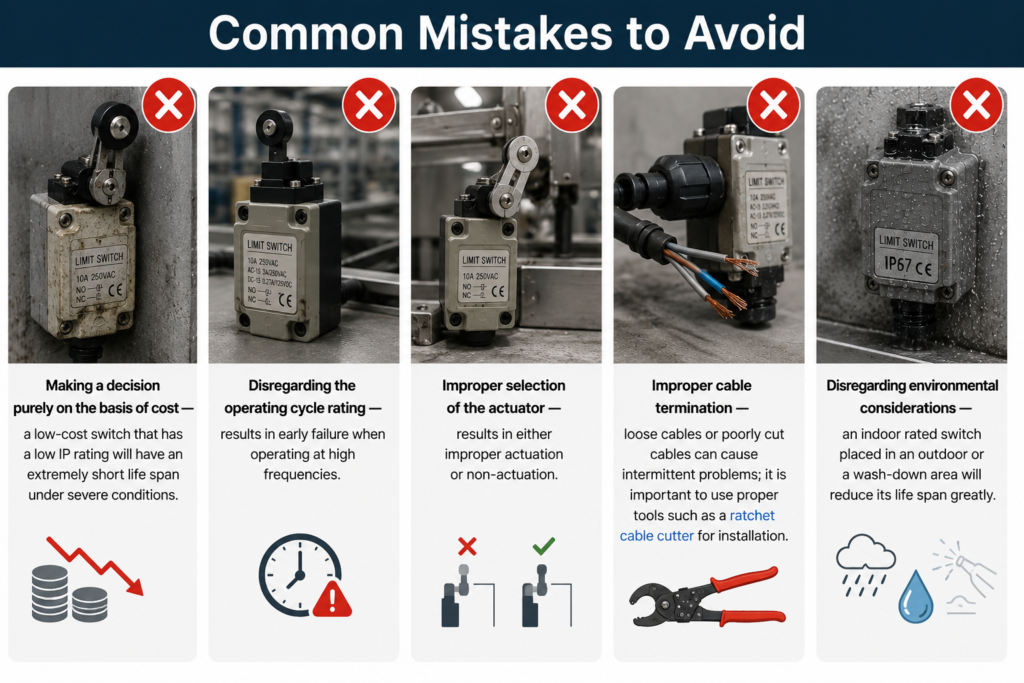
- Making a decision purely on the basis of cost — a low-cost switch that has a low IP rating will have an extremely short life span under severe conditions.
- Disregarding the operating cycle rating — results in early failure when operating at high frequencies.
- Improper selection of the actuator — results in either improper actuation or non-actuation.
- Improper cable termination — loose cables or poorly cut cables can cause intermittent problems; it is important to use proper tools such as a ratchet cable cutter for installation.
- Disregarding environmental considerations — an indoor rated switch placed in an outdoor or a wash-down area will reduce its life span greatly.
Choosing the correct limit switch for use in industrial automation does not only require selecting any switch that might work. You have to select a switch whose type, actuator, electrical rating and longevity match the requirements of your industrial automation. Selecting an appropriate limit switch ensures the safety of your machines and their longevity in use.
Moreover, never ignore the minor things when installing limit switches. Using the right tools for cable termination such as ratchet cable cutter can really pay off.
When installing automation systems, it is always advisable to purchase high-quality limit switches from a reputable industrial component supplier.
Frequently Asked Questions (FAQs)
Q1. What is the primary purpose of a limit switch?
A limit switch detects the position or presence of the moving body and sends out an electrical signal, used to control the operations such as stopping, starting or changing the direction of the machines’ movement based on the detected signal.
Q2. How do I choose what actuator to use with my limit switch?
Depending on the direction and speed of approach, you will need either a roller lever (for smooth contact), or a plunger-type limit switch (for direct contact).
Q3. Is there a special IP rating for outdoor or dusty environments?
If your limit switch is going to operate in outdoor, dusty or in wash-down conditions, the IP65 or above-rated limit switch is recommended to be used.
Q4. Is it possible to use one limit switch for both cranes and conveyors?
Usually, cranes use durable rotary or lever limit switches capable to handle heavy cyclic loads, while conveyors use compact plunger or roller limit switches that are used for high frequency triggering.
Q5. Why is cable termination important for limit switch installation?
Improper cable termination may lead to intermittent electrical problems, false triggering or to the malfunctioning of the switch itself. Ratchet cable cutter is the appropriate tool for making accurate cuts.
Q6. How often should limit switches be checked and replaced?
Inspection frequency depends on the level of usage, but it is usually recommended to inspect limit switches during regular maintenance, which means that the limit switches need to be checked monthly or quarterly depending on the level of usage.
Q7. What is the difference between a mechanical limit switch and a proximity sensor?
The difference between a mechanical limit switch and a proximity sensor is that in case of a mechanical limit switch, the physical contact is required, while in case of proximity sensor, the physical contact is not required at all.
Related Post:
How to Choose the Right Insulation Material for Electrical Applications