
Insulation material is one of those things that people only consider when something goes wrong. The transformer starts overheating, motor winding burns out, or the insulation of the cable fails during operation, and all of a sudden, the decision about material taken much earlier on becomes a topic of discussion. It’s not about ticking the technical box; rather, choosing the right insulation material can affect the lifespan of the equipment, its safety, and operating expenses.
This article considers the criteria that need to be taken into account before choosing the insulation material for any application.
Why Insulation Material Selection Matters
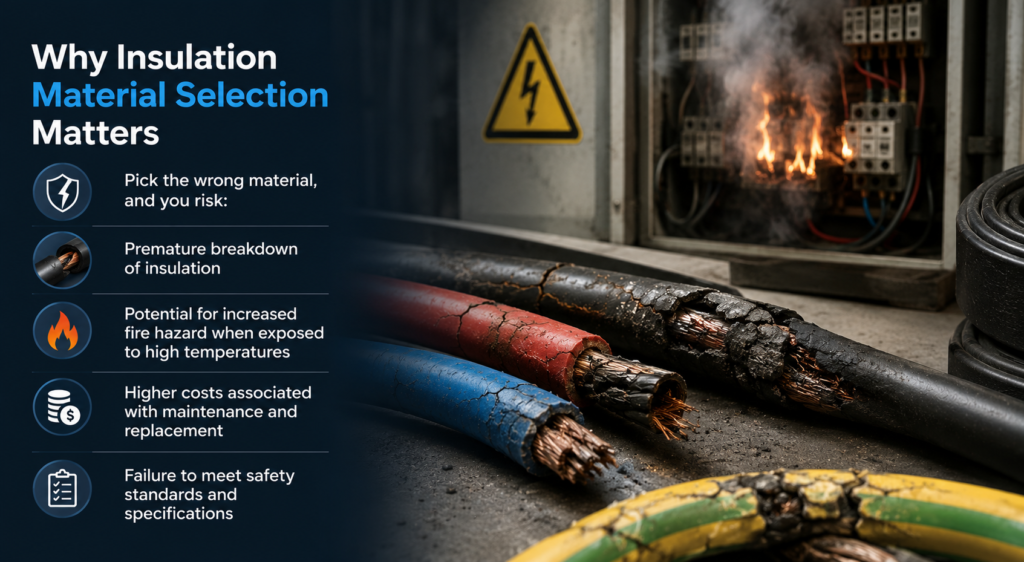
The electrical system ranging from home appliances to huge industrial transformers depends on insulators to ensure that electricity does not flow where it is not supposed to. Insulation is not limited to non-conductivity alone; it involves controlling heat, mechanical strength, chemical resistance, and maintenance of integrity throughout the period of usage.
Pick the wrong material, and you risk:
- Premature breakdown of insulation
- Potential for increased fire hazard when exposed to high temperatures
- Higher costs associated with maintenance and replacement
- Failure to meet safety standards and specifications
Considering the implications mentioned above, selection of insulation should be given the same weight as that of any other important electrical component.
Key Factors to Consider When Selecting Insulation Material
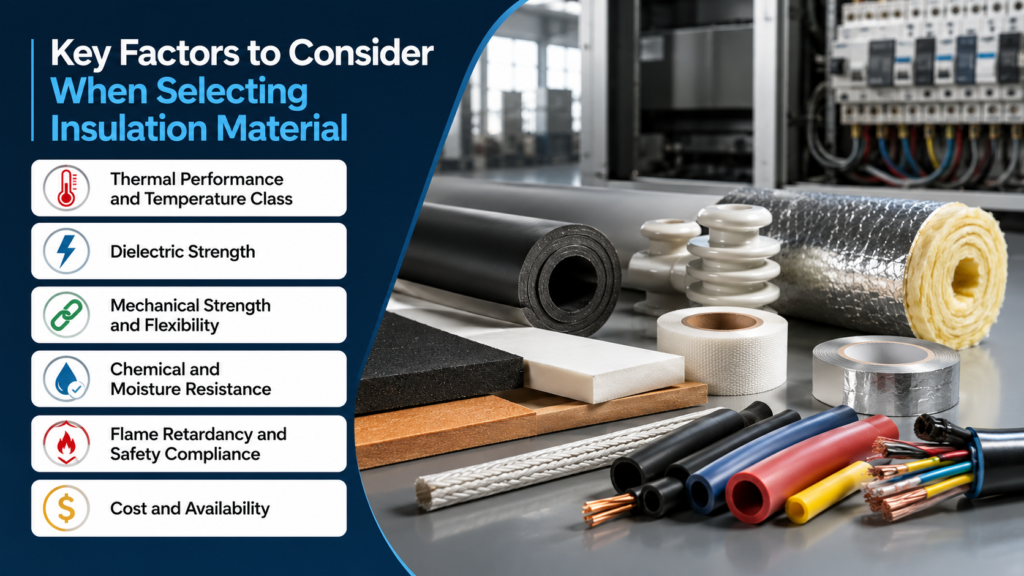
1. Thermal Performance and Temperature Class
All types of insulation materials have their own unique temperature classification and this is usually done in conformity with international standards, e.g. IEC 60085. Temperature classification gives the maximum temperature up to which the material remains good. Therefore, the use of the insulating material will depend on its temperature classification since electrical devices like motors, transformers, and generators generate much heat during operation.
Temperature classification that is high like H (180°C) is usually considered when selecting insulating materials for hard industrial applications.
2. Dielectric Strength
Dielectric Strength The term dielectric strength denotes the highest electric field that can be sustained by a material without causing breakdown. The dielectric strength of a material is critical in ensuring that there is no arcing or short circuiting or breakdown of the insulating material.
3. Mechanical Strength and Flexibility
It is very important for insulating materials to endure the pressure that might occur in various forms such as bending, vibration, stretching, or compression, according to their application. Insulating material used in motor winding must be able to bend without breaking and endure pressure during production and further vibrations.
4. Chemical and Moisture Resistance
There are situations where it is necessary to provide protection against the presence of oil, solvent, water vapor, or any kind of contamination in an electric circuit. In case the insulation breaks down because of contact with water vapor or any other chemical, it will fail to perform its duties before its time.
5. Flame Retardancy and Safety Compliance
Insulation breakdown being one of the common causes of electrical fires, flame retardancy becomes an essential feature of some materials. Insulation material must satisfy the standards on fire performance and self-extinguishing ability (UL, IEC, or regional).
6. Cost and Availability
Although performance considerations must not be ignored in the name of saving costs, cost considerations are indeed very much present in the choice of material, especially when large production volumes come into question. The objective is to look for a material that fulfills all engineering criteria without being too costly.
Comparing Common Insulation Materials
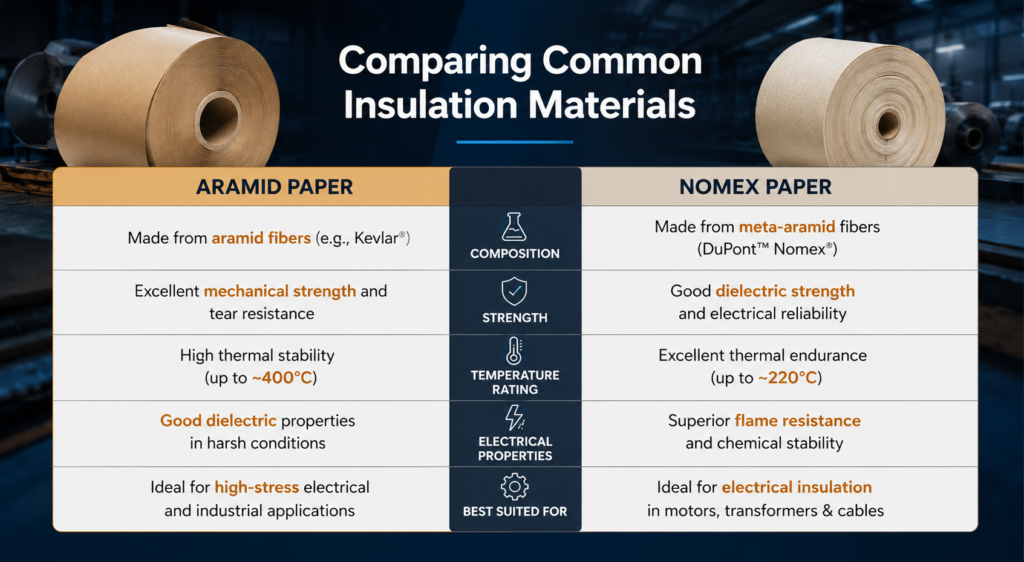
Electrical insulation materials can be classified into types like paper, films, resins, and composites, among others. From the category of paper-based insulation materials, two kinds that should be mentioned in electrical applications are aramid paper and Nomex paper.
Aramid Paper
The aramid paper is made up of aramid fibers characterized by their remarkable heat resistance and mechanical properties. It is applied in various electrical insulation uses where there is the need to withstand high temperatures, including transformers, motors, and generators. The aramid paper retains its structural and insulative properties when exposed to high heat continually.
Key advantages of aramid paper include:
- Excellent resistance to heat, suitable for Class H insulating system
- High mechanical strength and tear resistance
- High dielectric constant even in moist or dirty conditions
- Durable due to long lifespan under thermal stress
Nomex Paper
One such high performing paper that enjoys wide recognition as an excellent electrical insulation material is the Nomex paper. With its remarkable physical properties, this paper is widely utilized in many electrical instruments such as transformers, motors, and generators among others that require high temperature insulation.
Nomex paper offers:
- Outstanding flame-resistant and self-extinguishing properties
- Exemplary dielectric qualities through a broad range of temperatures
- Chemical resistance and stability against aging
- Compatibility with transformer oils and other types of insulating liquids
There is an overlap of advantages in the two types of paper because Nomex is a known brand of aramid paper. The most appropriate selection depends on particular application needs, budget, and manufacturer specifications.
Matching Material to Application
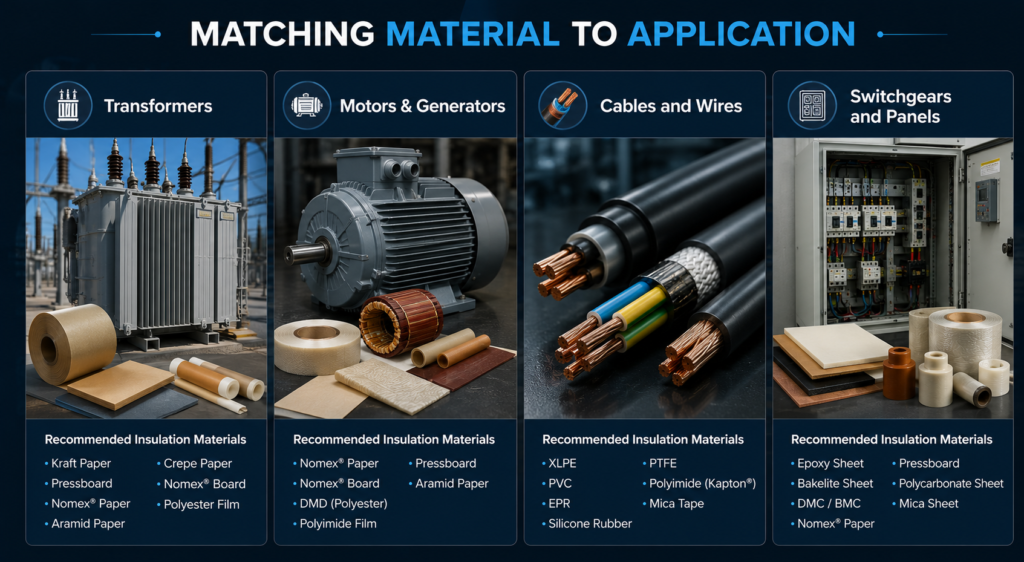
Different electrical applications call for different insulation priorities:
Transformers: Needs insulation which should have the capability to offer high dielectric strength and should be compatible with insulating oils besides having good thermal stability. Both Aramid paper and Nomex paper are suitable options due to their experience within transformers filled with oil as well as dry-type transformers.
Motors & Generators: Requires insulation which should be capable of handling mechanical stresses due to rotation and vibration while at the same time withstands the thermal stress. Papers of insulation falling in high temperature category are normally preferred.
Cables and Wires: Usually need insulation which is flexible and has moisture resistant properties.
Switchgears and Panels: Need insulation which can stand voltage spikes and offer proper dielectric insulation.
Steps to Make the Right Decision
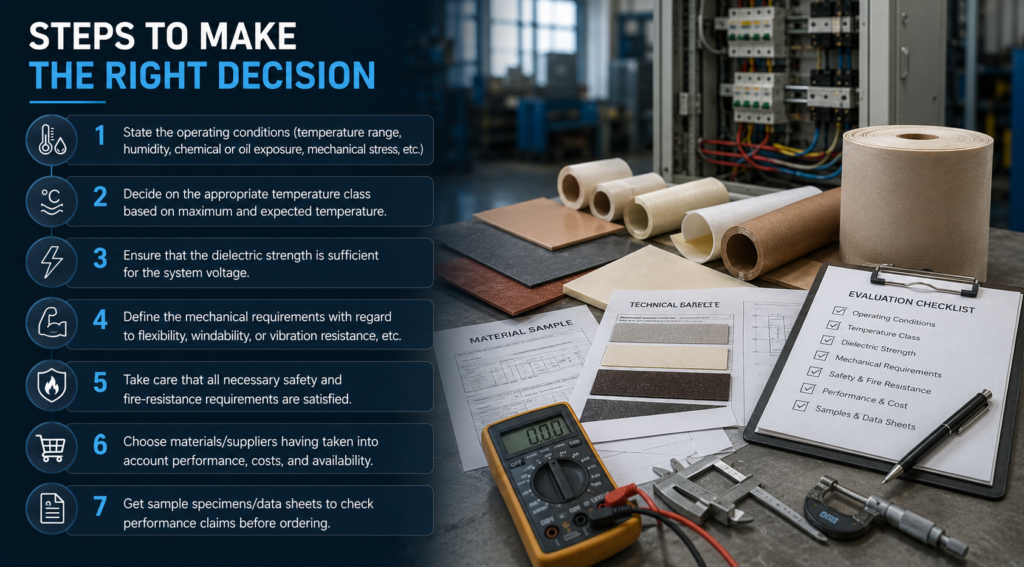
- State the operating conditions (temperature range, humidity, chemical or oil exposure, mechanical stress, etc.)
- Decide on the appropriate temperature class based on maximum and expected temperature.
- Ensure that the dielectric strength is sufficient for the system voltage.
- Define the mechanical requirements with regard to flexibility, windability, or vibration resistance, etc.
- Take care that all necessary safety and fire-resistance requirements are satisfied.
- Choose materials/suppliers having taken into account performance, costs, and availability.
- Get sample specimens/data sheets to check performance claims before ordering.
FAQ’S
1.What is the best insulation material for high-temperature applications in electricity?
Thermally resistant materials, including aramid paper and Nomex paper, are preferable in cases when it comes to high temperatures due to the retention of mechanical and dielectric strength even when constantly exposed to heat.
2.How does aramid paper differ from Nomex paper?
The thing is that Nomex is a brand name for a certain kind of aramid paper created by DuPont company. Thus, “Nomex paper” is just another type of aramid paper.
3.What class should I use for insulation of motor or transformer?
In case the device will operate at relatively high temperatures, it is better to choose class H materials with a maximum temperature limit of 180°C. The choice of a certain class will depend on the temperature of operation.
4.Does aramid paper possess moisture and chemical resistance?
Yes, aramid paper has moisture and chemical resistance. That is why it can be used in transformer oils and environments.
5.Why is dielectric strength an important property of an insulation material?
Dielectric strength defines the maximal voltage that can be applied to a material before the electrical breakdown occurs. That is why you should choose the material with dielectric strength greater than the voltage of your system.
Related Post: